


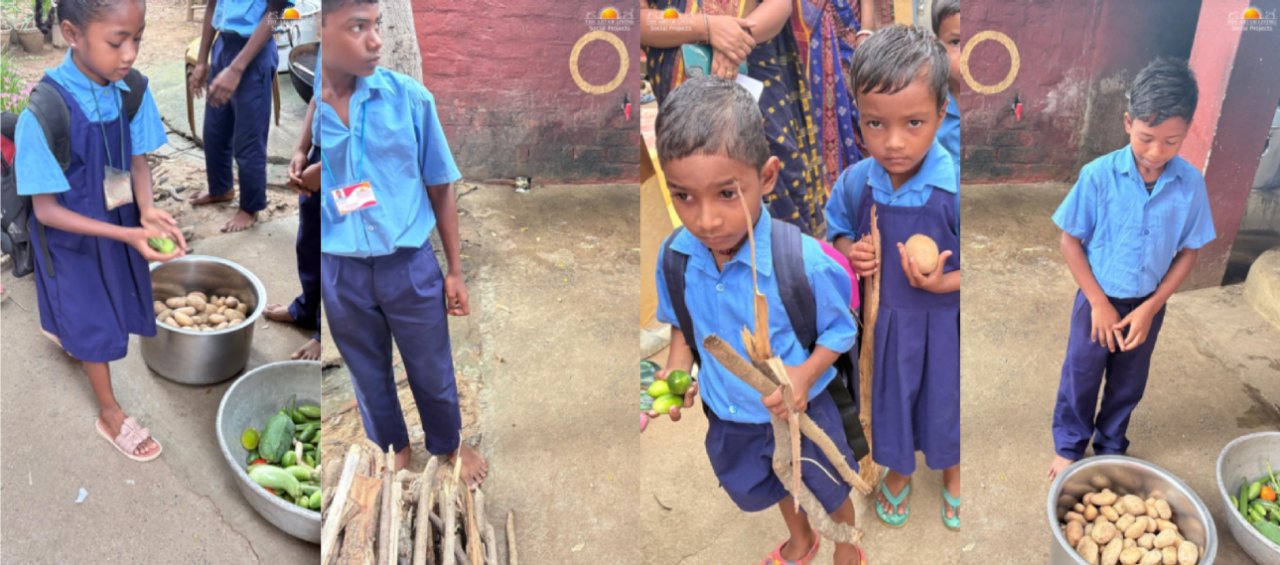
It is early morning in a tribal village. The school bell hasn't rung yet, but the children are already on the move.
They walk in slowly - each carrying a backpack, two sticks of firewood, and one vegetable. A boy holds a couple of limes in one hand and a bundle of dry wood in the other. A girl walks beside him with a potato pressed against her chest. Behind them, more children, more sticks, more vegetables.
This is not a special day. This is every day.
At the Art of Living Free Tribal Schools, this is a tradition the children follow each morning. Each child brings a small contribution from home. The firewood goes into a pile. The vegetables - potatoes, tomatoes, ridge gourd, okra, brinjal, whatever is in season - go into large steel vessels. By noon, all of it is cooked together into a meal that every child shares.
There is no menu. There is no caterer. But there is a feeling of community.
What strikes you when you watch this is the order. No one pushes. No one grabs. The children queue up, place their contribution into the vessels, and move on. There is a joy and quietness to the whole thing - a kind of discipline that doesn't come from rules pinned to a wall but from doing the same thing, together, every single day.
These children are learning something that most adults struggle with. They are learning that they are not just receivers. That even at six or seven years of age, they have something to give. That a shared meal - like most things worth having - is the result of many people doing a small part.
The Art of Living runs over 1350+ free schools across 20+ states in India. Most of the students come from tribal, rural, and urban slum communities. Many are first-generation learners - the first in their families to sit in a classroom, hold a pencil, read a sentence.
But some lessons don't need a classroom.
Some lessons walk in every morning, carried in small hands, wrapped in firewood and a single vegetable.
The Art of Living Free Tribal Schools provide holistic, value-based education to children from underserved communities at no cost.