


India's agricultural and domestic needs rely primarily on groundwater, accounting for 80% of the requirements, while only 20% is fulfilled by rain and water bodies such as rivers and lakes. With a sense of urgency, a committed team of The Art of Living experts undertook a vital mission to rejuvenate India's rivers and combat the alarming decline in groundwater levels.

Inspired by Gurudev Sri Sri Ravi Shankar's vision, highly skilled technical experts from The Art of Living took up the challenge of addressing the groundwater crisis and reviving India's dying rivers. Volunteers, known as Jal Sevaks, rallied alongside the experts, collectively striving to make India a better place to live. With meticulous planning, the team identified project sites across India and commenced rainwater harvesting using modern technology.
The team identified irregular rainfall, climate-related factors, and the overexploitation of water resources as significant causes of the crisis. Their comprehensive approach aimed to restore the hydrological cycle and rejuvenate water bodies, involving environmental scientists, geologists, hydrogeologists, and Geographic Information Systems (GIS) experts. Together, they devised a multi-pronged strategy to maximise water conservation.
The team constructed improvised structures across open land expanses to restore surface water bodies. These enhanced rainwater percolation through soil strata, replenishing groundwater aquifers. Local communities were actively engaged through capacity-building and training programmes, fostering a sense of ownership and long-term sustainability. Afforestation and soil conservation measures further complemented the conservation efforts.
Incorporating innovation into natural conservation methods, the team integrated Internet of Things (IoT) technology with rainwater harvesting. By using IoT-based sensors to monitor borewells and measure water-level fluctuations and soil moisture, they empowered farmers with real-time data to optimise water usage. This approach encouraged water budgeting and ensured balanced water utilisation.
One of the selected project locations was the Thippagondanahalli catchment area in Karnataka, a vital source of drinking water for Bangalore. Covering 460 square kilometres, the team constructed 2,700 groundwater recharge structures along river streams with the invaluable assistance of volunteers. Over eight to ten years, the project was implemented across 278 villages, driven by the experts' and volunteers' unwavering determination.
The team strategically built boulders, recharge wells, and injection wells tailored to the specific requirements of each location. Additionally, water pools were created to store surface and groundwater, ensuring a year-round water supply. Tree plantation played a pivotal role, with the team constructing eco-restoration cells around these water pools, attracting bees and birds. Continuous tree plantation by experts and volunteers helped replenish aquifers and facilitate river flow.
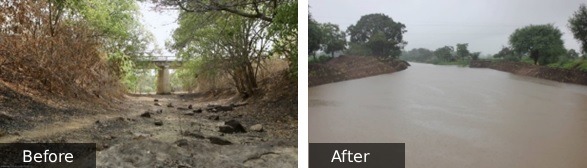
Kumudvathi River before and after the project intervention
The project's impact extended to the Kumudvathi watershed on the left bank of the Cauvery River. This overexploited catchment area in Karnataka witnessed ecosystem restoration through tree planting and the construction of recharge systems. More than 2,500 structures were built, benefiting over 190,000 people across 200+ villages. Additionally, more than 86,000 trees were planted, creating a positive environmental impact. A trial run of IoT-based water-level sensing was conducted in six villages, enabling optimal water utilisation and helping maintain river basin balance.
The achievements of The Art of Living's Water Conservation Projects are noteworthy. More than 70 rivers and streams have been rejuvenated across over 59,000 square kilometres in eight states. Over 7,00,000 trees have been planted along river basins, and around 90,500 structures have been constructed, positively impacting the lives of 34.5 million people.
The dedication, vision, and willpower demonstrated by the experts and volunteers have produced tangible outcomes. The Art of Living has played a crucial role in inspiring the nation to rejuvenate its rivers and address water scarcity. By combining technical expertise, community engagement, and innovative approaches, the organisation has offered hope for a future where water resources are conserved, rivers flow, and lives flourish.